

Afrikaner Broederbond, an exclusionist secret society and the development of remote small community of Monyakeng.
Perhaps it should be clear-cut from the onset that the subject under scrutiny here is the role and significance of the so-called elites in poverty-stricken communities. As the writer, I will seek to establish the conditions under which Broederbond came into existence and its role in empowering and developing the Afrikaners. Furthermore, I will indicate the conditions Monyakeng finds itself in,and establish whether they are not permissible for the formation of the Broederbond. However, it is important that this article should not be construed as an eulogy for a racist Afrikaner organization.
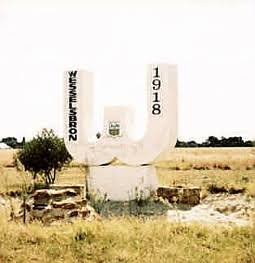
Broederbond owes its emergence to an attempt of organizing the Afrikaner nation after they have suffered a decisive defeat in a battlefield against the Britons.The Anglo-Boer War of 1899-1902 had after effects so painful to the Afrikaners that some committed suicide to beat British concentration camps to death. The Afrikaners had been humiliated in the war and consequently subjected to the second class citizen status in a land they felt strongly entitled to.The after effects of war were much harsher to the rural Afrikaners (farmers who had hitherto only knew farming as a means of survival), who were subjected to dislocation processes and forced to migrate to urban areas where they arrived as unskilled laborers vulnerable to economic exploitation (Van Rooyen, 1994).The subsequent years saw the Afrikaners experiencing devastating levels of poverty,this is despite the continued attempts by economically successful Afrikaners to counteract the situation in their individual capacities. The broederbond was formed in 1918 as another attempt to unite the Afrikaner nation by the economically developed Afrikaners.In essence, the foundation of Afrikaner Broederbond was a culmination of the failed attempts hitherto to unite and develop the Afrikaner society.It is worth noting that the front was founded by only 37 men,these were the people who would determine the fate of South African society for the next decades.With its founding leadership, H.J Klopper(Chairman),D.H.C du Plessis(Secretary),and J.E Reeler(Treaurer), the Broederbond resolved to highly appreciate the value of secrecy in their dealings (Van Rooyen, 1994).These 37 Afrikaner men collectivized their resources in order to help improve the situation of their nation.This collectivization of resources,over the years,would see the successful establishment of corporations like Nationale Pers, Santam, Sanlam, Federale Volksbelegging, Ko-operatiewe Wijnbouwers Vereeniging(KWV) and Afrikanse Begrafnis Onderneming Beperk(AVBOB) inter alia.These corporations would employ and serve the interests of the Afrikaners,and therefore economically and socially improving the life standard of Afrikaners. As for politics, Broederbond was de facto the government of apartheid South Africa because all apartheid presidents were members of Broederbond.
But what has Broederbond got anything to do with Monyakeng?
In an attempt to answer what may seem as ridiculous yet a pertinent question, it might be important to realize that Monyakeng owns nothing that contributes to the economy of Monyakeng. Your LFC,Omnia/Senwes,Meadow Meats,in fact the industrial zone,by and large is privately owned by companies that have no interest at all of economically or socially giving back to the community that they operate in.The community of Monyakeng is only good to these companies because it provides them with immediate cheap labour (sometimes construed as employment opportunities).
According to Statistics South Africa(2011), Monyakeng has the population of 25,392,of this population 59,4% fall under the Working Age,this should not be construed as the percentage rate of employment, so not less than 15 000 people are eligible to work but it is uncertain whether they are employed or not, only 20,7% have matric certificates,and 3,5% received higher education(meaning only 914 of 25000 people have either certificates,diplomas or degrees). In terms of economy,the highest bar of the graph for Household Income on Statistics South Africa(2011) findings is 24,7% and they earn between R19,601 and R38,200 per annum. Now if one made his calculations, the answers would serve as signposts of where this group is employed at. The extremely low number of educated people, a 14% of the population without any source of income, a great part of the population without job prospects and poverty should all serve as indicators for a defeated and humiliated society.These are conditions not so different to those that necessitated the formation of Broederbond.
To get the right answers one must ask the right questions:
What prevents teachers of Monyakeng to unite and resolve to establish a trust fund whose contributions made by each teacher would serve to educate a single student to study, for example, Medicine so the community of Monyakeng can produce a doctor that would serve it?
What prevents the financially sound individuals to come together,collectivize their resources and draft a five year plan that would see the establishment of businesses that would employ and serve the community of Monyakeng?
Are these questions even pragmatic?
Additionally, is the role of civil society only limited to criticizing the corruption in municipality offices?
And is the role of religious leaders only limited in their churches?
The answers to these may not be clear cut but one should remain optimistic, for hope is all we have.